
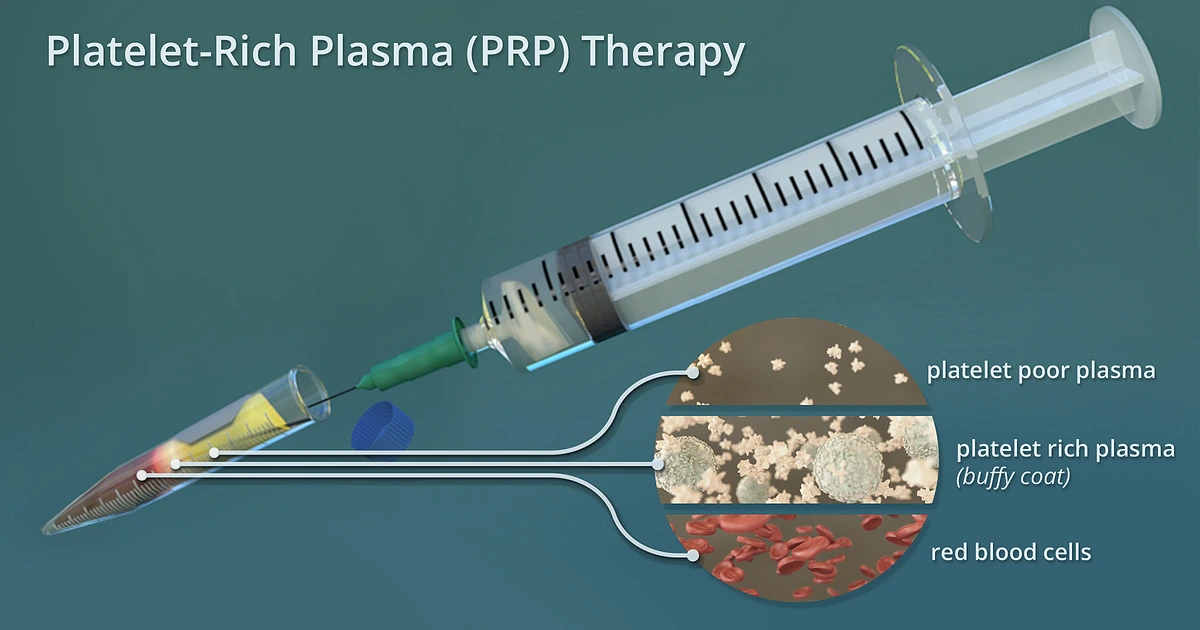
You may have heard some of the world’s most elite athletes getting PRP (platelet-rich plasma) injections to help an injury, including golfer Tiger Woods, tennis star Rafael Nadal, and baseball’s Takashi Saito. What exactly is PRP, and how does it work?
What is platelet-rich plasma?
Platelet-rich plasma therapy uses platelets’ regenerative ability and natural growth factors to heal tissues. Blood contains mainly a liquid called plasma and small solid components (red cells, white cells, and platelets). Platelets are best known for their importance in blood clotting, but they also contain proteins called growth factors that play an important role in healing injuries.
PRP is plasma, where platelet concentration is much higher than in blood. Increased concentration of platelet leads to increased concentration of growth factors.
How is PRP prepared?
Blood is drawn from the patient in special tubes. These tubes are kept in a machine that separates the platelets from the other components of the blood. The platelets are removed and then injected directly into the injured area. This releases the growth factors stored in the platelets, which stimulate and increase the number of reparative cells your body produces.
How does PRP work?
Increased concentration of growth factors in PRP can potentially improve the healing process. PRP is used in one of these ways;
⦁ Directly injected into the affected area
In conditions such as Tennis elbow, ligament sprains, and early OA, PRP or a mixture of PRP and local anesthetic is injected directly into the affected area. After the injection, the patient may feel an increase in pain for a few days, after which the beneficial effect starts to appear.
⦁ Improve healing after surgery.
Sometimes, in ligament surgeries, PRP is used to quicken healing and rehabilitation. It can be injected into the tissue during surgery or later in the post-operative period.
What conditions are treated with PRP?
Many tendon and ligament problems have shown improved healing with PRP injection. PRP is also very effective in the mild to moderate stage of knee osteoarthritis.
Tendon Injuries
PRP is very effective in treating chronic tendon injuries, such as tennis elbow. It reduces internal inflammation and, hence, pain in the elbow.
PRP is also used to treat Achilles tendinitis and Jumper’s knee (inflammation of a patellar tendon in the knee).
Ligament and Muscle Injuries
Sometimes, PRP is also used in acute sports injuries in athletes, such as knee sprains and pulled hamstrings.
Knee Arthritis
PRP is very effective in treating early to moderate knee osteoarthritis. Recent studies have shown that patients may get relief for up to 1-2 years with PRP treatment.
Conclusion
PRP is effective in treating chronic tendon problems with minimal side effects. The patient may feel increased pain at the site initially, but it resolves, and the benefits of PRP start to show. If you are considering PRP treatment, you should discuss it with your orthopaedician.