
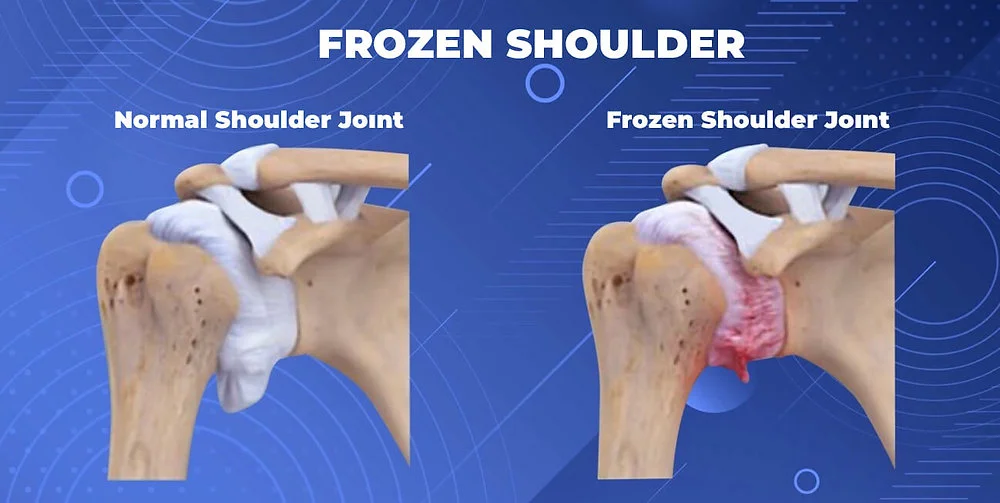
A very common shoulder problem is a Frozen Shoulder. In this condition, the patient complains of continuous pain in the shoulder with decreased movement. Usually, the pain is more intense at night and increases with movement.
In this condition, the primary pathology is inflammation and thickening of the shoulder covering (capsule). The more pain the patient feels, the less the patient moves the shoulder, hence the term ‘Frozen Shoulder’. This lack of use makes the capsule thicken and tighten more, thus increasing the problem. It is a vicious circle that needs to be broken to treat this condition. If left untreated, it can take 3-4 years to resolve with a lot of suffering.
Who is at risk?
Age: Middle-aged people, generally between 40-60 years of age.
Gender: Women>Men
Diabetes: 10-20% of people with diabetes develop frozen shoulder.
Recent shoulder injury
Treatment
Most people with frozen shoulders improve with simple treatments.
Our objectives are:
1. Pain relief
2. Getting movements back
· Anti-inflammatory medicines
This group of medicines decreases the inflammation inside the shoulder, thus reducing pain and increasing the movements.
· Physical Therapy
Stretching and range of motion exercises can be done at home to increase shoulder movement.
· Steroid injection
Steroids are powerful anti-inflammatory medicines. When injected inside the shoulder, they act directly on the inflamed capsule, giving maximum relief.
· Manipulation under Anesthesia
If the above treatments do not relieve symptoms, the next step is manipulation under anesthesia. The patient is put under anesthesia, and the shoulder is moved through its complete movements with some force. This breaks all the adhesions inside the shoulder and the tight capsule as well. Post-procedure movements are considerably increased, and physiotherapy is done to prevent the recurrence of adhesions.
· Surgery – Arthroscopic Release
Very few patients do not benefit from any kind of treatment. The arthroscopic release is indicated for this subset of patients. In this surgery, pencil-sized instruments are used, and the inflamed and tight capsule is cut, freeing the shoulder joint. The adhesions inside the joint are also cut, making the movements accessible.
Prevention
· Get your sugar levels and thyroid levels tested regularly. Deranged levels increase the risk of a frozen shoulder.
· After a shoulder injury, start physical therapy as soon as possible. Consult a doctor to develop a rehabilitation protocol, depending on the injury.